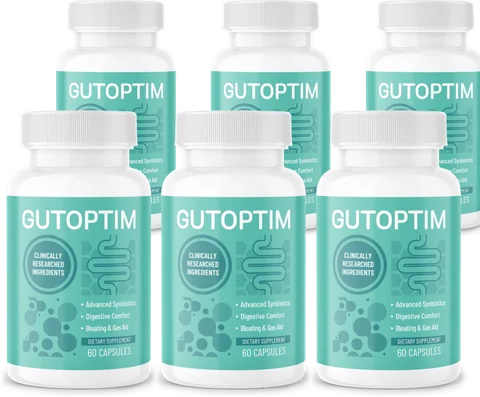
A supplement label tells you the product name, how many capsules are inside, the directions and the ingredients. GutOptim™ lists 60 capsules per bottle, directs two capsules daily with plenty of water, and names nine ingredients: bentonite clay, L. acidophilus, black walnuts, aloe vera, konjac glucomannan, flax seeds, prunes, oats and apple pectin.
Start at the top: name, count and directions · The nine ingredient names · Why the order and wording matter · Words you will see on the bottle · Turning label reading into a habit
- Start with the capsule count and directions, then move to the ingredient names.
- The brand names nine ingredients in all.
- Several are familiar foods, and a few are plants or minerals with interesting backgrounds.
- Reading a label calmly is a skill that pays off with every product you buy.
Start at the top: name, count and directions
Every good label reading begins with the basics. At the top you find the product name, the form (capsules) and the count. For GutOptim, a bottle holds 60 capsules, and the brand's directions are two capsules daily with plenty of water. Put those together and you can see that a bottle covers 30 days.
Taking a minute to do this arithmetic means you always know when to reorder. It also makes comparing any two products fairer, since you are comparing days of supply instead of bottle sizes. The What is GutOptim page covers the same basics in a friendlier format.
The nine ingredient names
Next comes the ingredient list. The brand names nine ingredients for GutOptim. In plain terms, here is what each one is:
Notice the mix. Three of the nine are ordinary kitchen foods, one is a mineral clay, one is a named bacterial species, and the rest are plant parts or plant fibers. That variety is exactly why a quick glossary helps when you look at the bottle.
- Bentonite clay: a fine clay formed from weathered volcanic ash
- L. acidophilus: short for Lactobacillus acidophilus, a named bacterial species
- Black walnuts: the nuts of a North American tree
- Aloe vera: a succulent plant with thick, gel-filled leaves
- Konjac glucomannan: a fiber taken from the root of the konjac plant
- Flax seeds: small seeds from the flax plant
- Prunes: dried plums
- Oats: the familiar cereal grain
- Apple pectin: a gel-forming plant fiber found in apples
Ready to start your routine?
GutOptim: a daily capsule routine with two capsules daily and a 60-day money-back guarantee.
Order GutOptim NowWhy the order and wording matter
On many labels, the sequence of an ingredient list follows a convention, so it is worth glancing at how things are arranged. The wording matters too. Notice that some names are everyday foods, while others, like glucomannan or L. acidophilus, use scientific terms that are easier to understand once you know what the words mean.
This article sticks to names and plain descriptions. The brand does not give amounts in the material covered here, so the best approach is to read ingredient names as just that: names. For a closer look at each, the GutOptim formula page goes ingredient by ingredient.
A handy trick is to circle, mentally or on paper, any word you would not say at the dinner table. Then look each one up in a reliable source. Within ten minutes, an intimidating list becomes a set of simple, understandable names.
Words you will see on the bottle
Beyond the ingredient list, you will meet a few phrases that appear on many supplement labels. The brand describes GutOptim as made in the USA, produced in a GMP-certified facility, non-GMO and natural. GMP is short for good manufacturing practices, the production standards a facility follows. These are the brand's own statements about the product.
If you enjoy decoding labels, the NIH Office of Dietary Supplements at ods.od.nih.gov publishes friendly fact sheets on many common ingredients, and the FDA dietary supplements page explains general labeling basics.
Also look for the lot code and expiration date printed on the bottle. They are useful to keep handy for your records, and they tell you the bottle is current when it arrives.
Turning label reading into a habit
Reading a label from top to bottom takes about two minutes once you have done it a few times. Check the count, check the directions, scan the ingredient names, and look up any word you do not recognize.
That habit works for every pantry item and every product you bring home. When you are ready to order, the pricing page shows the 1, 3 and 6 bottle packs, each backed by a 60-day money-back guarantee counted from your purchase date.